| Home Welcome |
world
 |
|
|
|
|
|
|
|
|
|
| DEVELOPMENT DRAFT The only stable URL is http://www.vendian.org/howbig/. Comments encouraged - mncharity@vendian.org (Mitchell Charity) |
How Big Are Things?
|
small | Real world
|
big | solar system | between | galaxy | ||||||||||||||||||||
nano
|
micro
|
meter
|
kilo
|
Mega
|
Giga
|
Tera
|
Peta
|
Exa
|
||||||||||||||||||
| kilometer's Room - looking at a sheet of graph paper |
|
look at the entire room |
|
| galaxy | 21 | |
 | ||
| 20 19 | ||
| local stars | 18 | |
 | ||
| 17 16 | ||
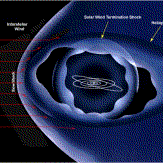
| between | 15 | |
 | ||
| 14 13 | ||
| E's orbit | 12 | |
 | ||
| 11 10 | ||
| sun | 9 | |
 | ||
| 8 7 | ||
| texas | 6 | |
| 5 4 | ||
| hood | 3 | |
 | ||
| 2 1 | ||
| you | 0 | |
 | ||
| -1 -2 | ||
| salt grain | -3 | |
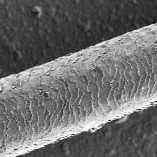 | ||
| -4 -5 | ||
| bacteria | -6 | |
 | ||
| -7 -8 | ||
| atom | -9 |
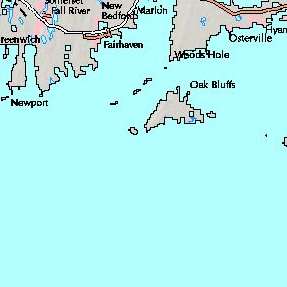
 1 km 10 km 100 km
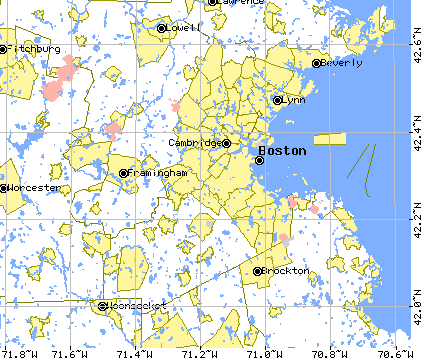
US Census Tiger Map Server
Their "Scale" may not say 1:1000000 because they assume a 75bpi screen.
| miles (mi) | |||||
| 0 |
10 |
20 |
30 |
40 |
50 |
| ||||||||||
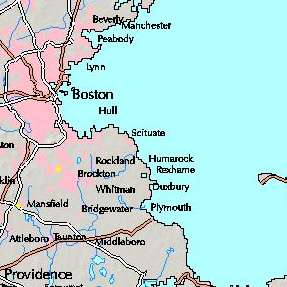   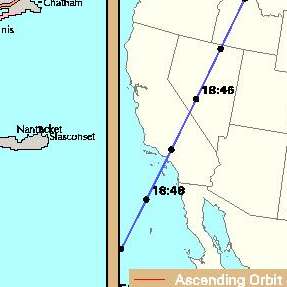 |
|
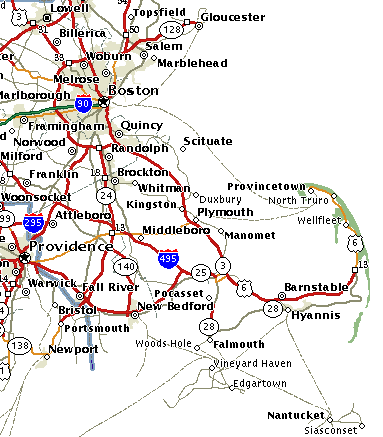 (c) MapQuest.com | |
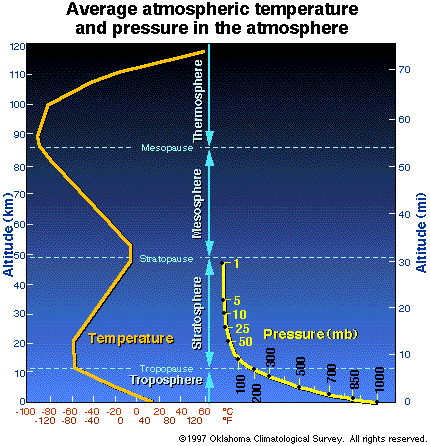
 | average atmosphere 10% and 50% pressure heights |
 | |
 | crust |
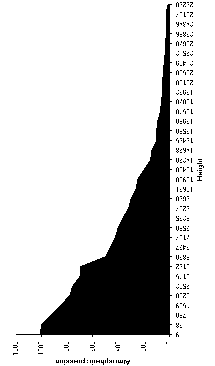 height heightair pressure |
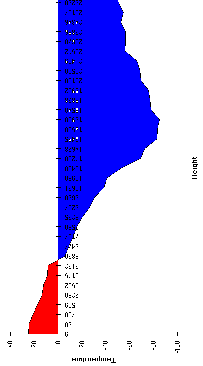 temperature |
visible horizon
 at eye-height;
at 10 m;
at 100 m;
at eye-height;
at 10 m;
at 100 m;
(distance to horizon is ~100 × sqrt(height))
src
(neglecting topography of course. eg, in smooth seas)
Wildfire (Arizona, June 2002)
(zoom out 10x)

Image (1 MB) from here. About 300 thousand acres burned. |
 106 acres (106 is a million) |
Earth's crust - thickness:
|
 |
|
||||
|
|
|
|
|
|
Crustal thickness maps: Global, another, 2°; North America; histograms Maximum thickness results from a "double" crust - one plate pushed under another. |
|
oceanic ~min / ~ave / ~max |
||||||
|
continental ~ave / ~max |
||||||
 |
atmosphere (ave 10% and 50% pressure heights) mean ocean depth ocean crust (mostly 7±1 km) |
|
|
land height (maximum and average) | |
 |  |
ocean depth (max, ave) | |
 Antartic ice sheet
  |
Rule of thumb: atmosphere presure decreases by about 1/3 per 7 km. 1/27 (4%), 1/9 (10%), and 1/3 (30%) |
 Thumbnail of meter Room floor.

src,
image
This image is only very roughly aligned with the one below.
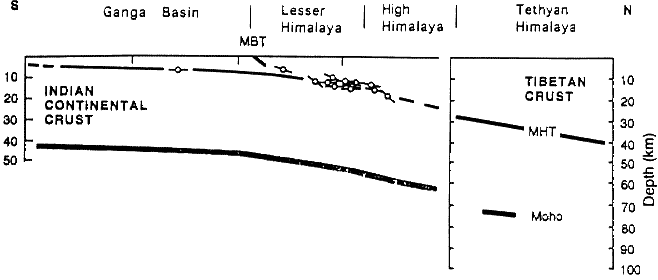
source This diagram stops at sea level - land surface height is not shown. :( Eg, Everest is this high.
Pacific crust decending under Oregon Info here.
There is a scale map on the floor.
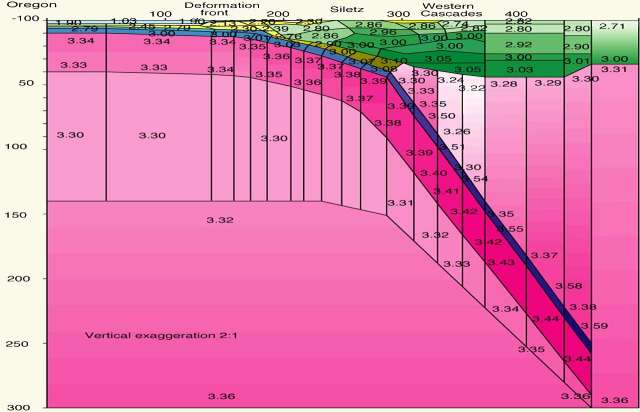 Numbers are density (g/cm^3) - light rock floats higher. You can see the thin blue ocean upper left. <- West, East -> The "-100" depth under "Oregon" is a typo - it should of couse be "0". |
 |
... | |
?...? |
| neutron star | |||
(c) 2000-2003 Mitchell N Charity. All rights reserved.
Noncommercial use is fine. Otherwise, ask.


